River of News
I liked
Drawings of Blue Sky Backgrounds... from pixivision
Characters under the blue sky are beautiful
Sign guestbook:https://binarydigit.neocities.org/
Comment:"I like your blogroll. I just found out...how to create blogroll using Miniroll."
Naruto style T-shirt (Here is affiliate link)
(Affiliate Link: The website owner may earn a commission from qualifying purchases.)
Naruto, One Piece and Bleach are Big Three
Reply to thread on Mangahelpers forum
Topic:"What are You Watching and What is Next on Your List? "
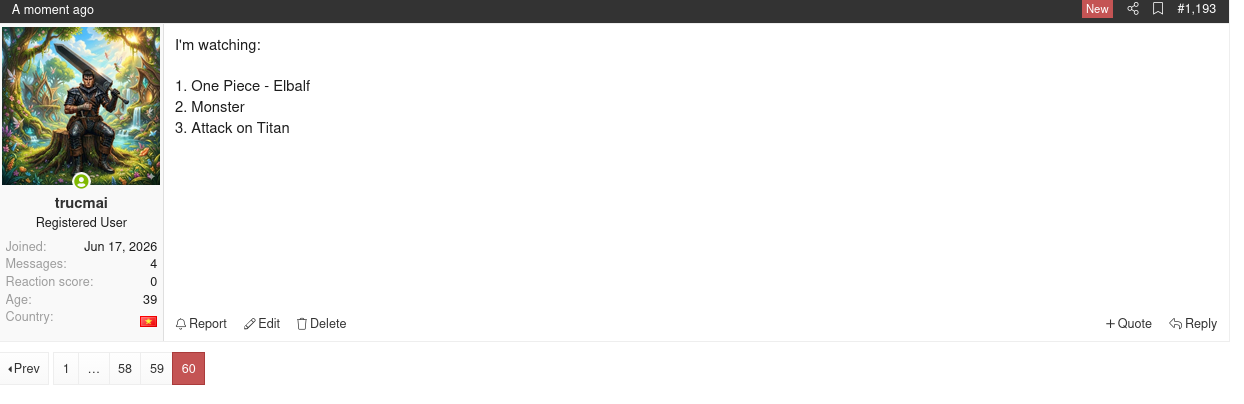
Comment:"I'm watching:
1. One Piece - Elbalf
2. Monster
3. Attack on Titan"
Luffy and his all nakama of Straw hat Pirates at the Grevin Museum
One Piece is the first Japanese anime.There are many discounts...
I liked
Hunter x Hunter Manga Surpasses 100 Million Circulating Copies, Celebration Event Announced by Marko Jovanovic
Takumi Sumino Ani-Badge** (Here is affiliate link)
(Affiliate Link: The website owner may earn a commission from qualifying purchases.)
Takumi Sumino (澄野 拓海) is the protagonist of The Hundred Line -Last Defense Academy
Otaku forum supports GIF
Announcement:"Minna-san, OtakuForums now supports GIFs. No more describing Gojo's smug face with words. Just click on the [GIF] button on the toolbar when you are posting."
Comment_______ 
Source: https://web.archive.org/web/20091025002445/http://geocities.com/animewallsea/awardspage3.html
Slam Dunk, basketball anime by @LucasDeRuyter & @Coop Bicknell
Like Tsubasha, Slam Dunk is also one of the great sport manga.
Nendoroid Witch Hat Atelier Coco (Here is affiliate link)
(Affiliate Link: The website owner may earn a commission from qualifying purchases.)
Witch apprentice restore her mother because her fault
Reply to thread on mangahelpers forum
Quote:"Uranus was hidden by Oda until today. We have very little information about Uranus, b ut I believe I found a fitting candidate in the manga.
By now I also assume that Uranus – or at least a part of Uranus – was responsible for the destruction of Lulusia.
In the community, two panels from Enel’s cover story are very well known. And for good reason."
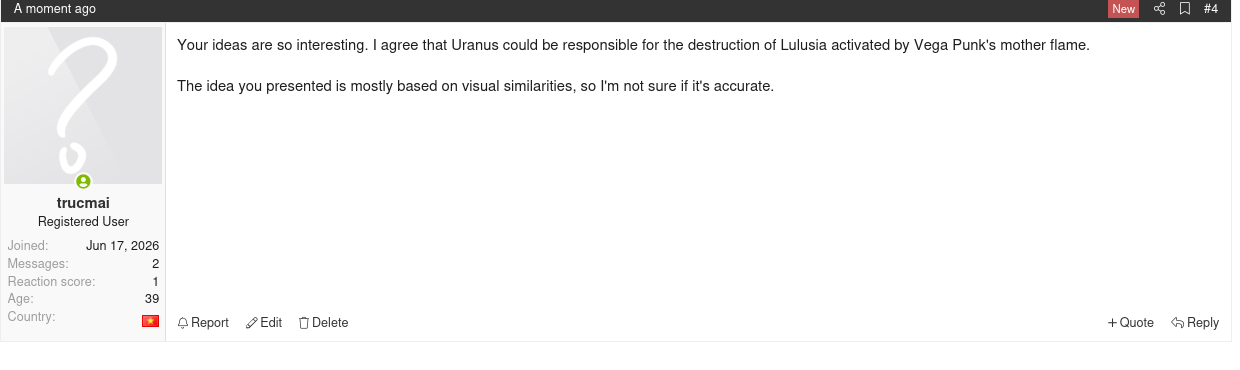
Comment:"Your ideas are so interesting. I agree that Uranus could be responsible for the destruction of Lulusia activated by Vega Punk's mother flame. The idea you presented is mostly based on visual similarities, so I'm not sure if it's accurate."
I liked
2025 Spy×Family Stage Musical Gets Paid Streaming Outside Japan With English Subtitles by Joanna Cayanan
Universal Studios Japan made our Frieren fan cry
Everybody say Frieren, Delicious in Dungeon and Witch Hat Atelier are Big Three of fantasy anime
Fan Art of Star Wars... from pixivision
Let's discover fan art of Star War on Pixiv
I liked
Crunchyroll’s Smoking Behind The Supermarket With You mini-episodes
[1st–12th] Touhou M-1 Grand Prix Complete Season 1-2 (Here is affilite link)
(Affiliate Link: The website owner may earn a commission from qualifying purchases.)
When you are looking back on the series' origins
Super Mario Bros. Copy, legend of game
For me, it's the best Mario version. My childhood
My favorite mascot Totoro on futon bedding
So cute („• ֊ •„). Now futon bedding appears in its anime store
Reply to thread on Mangahelpers forum
LIAR GAME-Synopsis
Comment:"I watched live-action :)"
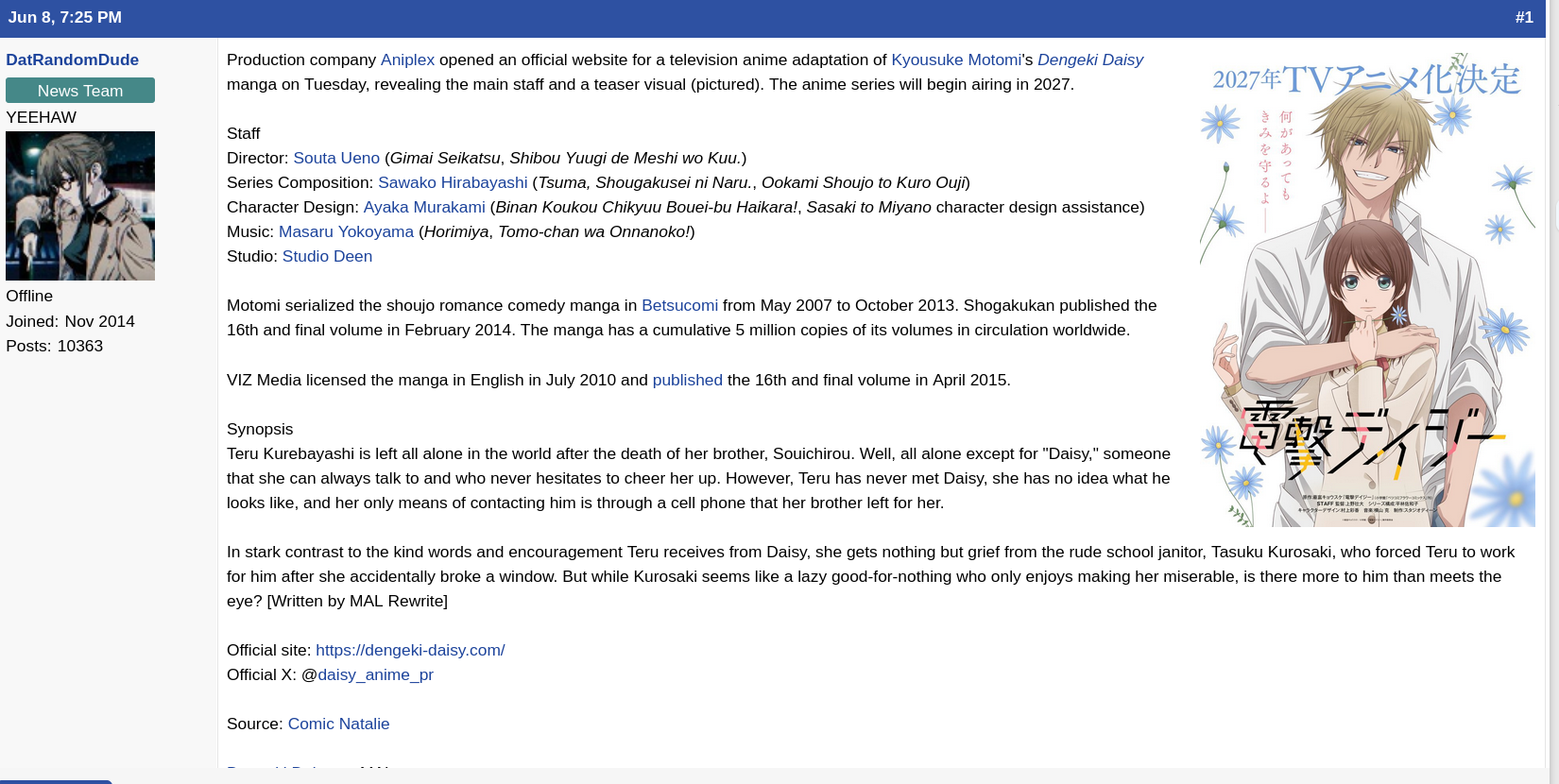
Manga 'Dengeki Daisy' Gets TV Anime Adaptation in 2027 by DatRandomDude, News team
Reply to thread on Myanimelist forum
"Production company Aniplex opened an official website for a television anime adaptation of Kyousuke Motomi's Dengeki Daisy manga on Tuesday, revealing the main staff and a teaser visual (pictured). The anime series will begin airing in 2027."
Comment:"I'm looking forward!"

Gundam Forum Thread by ayase
ayase, State Alchemist of Anime UK news has decided to bring back a "free" thread for talk about any and all things Gundam.
Resident Evil (1996) by Joel
Game review of Joel about a Survival Horror genre
BANDAI 2015 Dragonball Heroes Mcdonalds Happy Meal Cards(Here is an affiliate link)
(Affiliate Link: The website owner may earn a commission from qualifying purchases.)
Dragon ball, my child hood
Viz Media has licensed manga for print in English
Jujutsu Kaisen Modulo, Detective Conan, Slam Dunk Deluxe Edition...
Creating narrative content games
Include 4X strategy games, puzzle games, multiplayer games, ARPGs...
Reply to post on ani.social
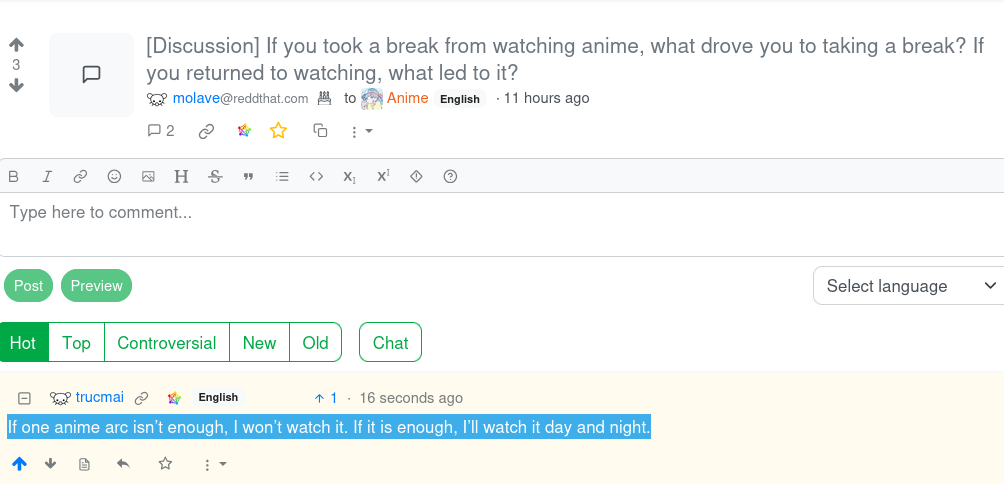
[Discussion] If you took a break from watching anime, what drove you to taking a break? If you returned to watching, what led to it?
Comment:"If one anime arc isn’t enough, I won’t watch it. If it is enough, I’ll watch it day and night."
New post on Fluxblog, one of the first MP3 blog by Matthew Perpetua
Indie pop singer Aurora, Norwegian has Tomora that colloborates with Tom Rowlands of The Chemical Brothers
edwinwenink.xyz by Edwin Wenink
edwinwenink.xyz is a digital garden.
He explained about archive fever.
"Over the years I have occupied myself with studying such diverse topics, only to realize that I can barely recollect half of it. Now I suffer from the nostalgic desire to retrieve what is forgotten and to build a grand archive to preserve everything, such that it will not meet the same fate. This particular confliction is called Archive Fever, a term coined by Jacques Derrida."
He created a minimalist website. It only contains black text and white background.
He write about technology,website, machine learning.
You can reply his post via Webmention
Subscribe via RSS
Naoki Urasawa launchs new manga series
Urasawa has draw Monster, Pluto, 20th century boys. I'm watching Monster.
Drawings of Basketball - Slam Dunk from pixivision
Collection of basketball